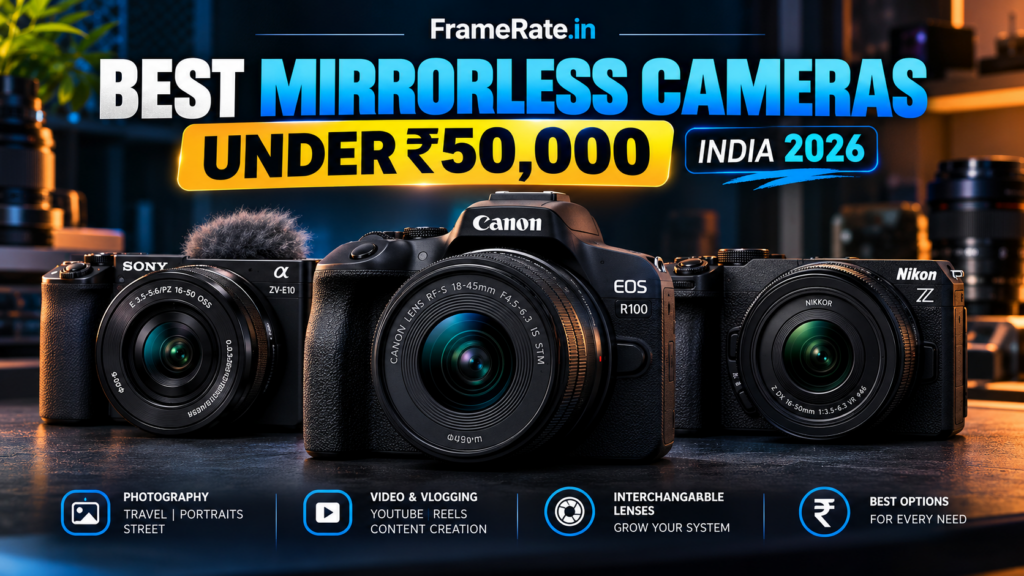
Buying a good mirrorless camera for less than ₹50,000 in India has become surprisingly difficult in 2026. Entry-level camera prices have moved upward, and several models that older buying guides still recommend in this budget now cost ₹60,000 or more when purchased new with an official Indian warranty.
That leaves one particularly strong genuine sub-₹50,000 option: the Canon EOS R100 with the RF-S 18-45mm kit lens, which has recently been selling for roughly ₹48,000–₹49,000 at major Indian retailers. Canon’s official MRP is higher at ₹64,995, so street pricing and offers matter considerably.
If your priority is photography, the EOS R100 is our best mirrorless cameras under ₹50000 in India right now. Its 24.1MP APS-C sensor, electronic viewfinder and interchangeable RF-mount lenses give a beginner plenty of room to learn photography.
Video-focused buyers face a harder decision. The R100 can record 4K, but its video implementation is dated compared with cameras such as the Sony ZV-E10 and Nikon Z30. Those are better creator cameras, but currently sit above the strict ₹50,000 budget. Sony lists the ZV-E10 at ₹61,990 MRP, while the Nikon Z30 kit has recently been around ₹66,000.
Our recommendation, therefore, is simple: buy the R100 if ₹50,000 is a hard ceiling. If video is your main priority, save a little longer rather than buying the wrong camera simply to stay below the number.
Best Mirrorless Cameras Under ₹50,000 — Quick Comparison
| Camera | Approx. Price | Sensor | Resolution | Mount | Max Video | Autofocus | EVF | Best For |
|---|---|---|---|---|---|---|---|---|
| Canon EOS R100 + 18-45mm | ₹48,000–₹49,000 | APS-C CMOS | 24.1MP | Canon RF | 4K 25p | Dual Pixel CMOS AF / Eye AF | Yes | Photography beginners |
| Sony ZV-E10 + 16-50mm* | ~₹60,000+ | APS-C CMOS | 24.2MP | Sony E | 4K 30p | Fast Hybrid AF / Eye AF | No | Video & YouTube |
| Nikon Z30 + 16-50mm* | ~₹66,000 | APS-C CMOS | 20.9MP | Nikon Z | 4K 30p | 209-point Hybrid AF | No | Vlogging / hybrid use |
| Canon EOS R50 + 18-45mm* | ~₹66,000 | APS-C CMOS | 24.2MP | Canon RF | 4K 30p | Dual Pixel CMOS AF II | Yes | Best step-up hybrid |
*These cameras are not normally under ₹50,000 in India at the time of writing. They are included only as alternatives worth considering if your budget can stretch or an unusually strong sale brings one close to ₹50,000.
Canon’s own store has recently listed the R50 kit at ₹65,990, while its official specifications include 24.2MP APS-C capture, oversampled 4K 30p and shooting at up to 15fps.
Prices change frequently during Amazon/Flipkart sales and manufacturer promotions, so compare the final price with the lens included rather than looking only at the camera name.
Our Top Picks
Best Overall Under ₹50,000: Canon EOS R100
The R100 wins by being the strongest camera that actually satisfies the budget. It combines an APS-C sensor, interchangeable lenses, Eye Detection AF and a proper electronic viewfinder with an 18-45mm stabilized kit lens.
Best for Photography: Canon EOS R100
Its biggest weaknesses concern video and interface design rather than basic still-image quality. That makes it much easier to recommend to someone learning portraits, travel, street and everyday photography.
Best for Video/Vlogging if You Can Stretch: Sony ZV-E10
The ZV-E10 is a more sensible creator camera because of its fully articulating display, strong autofocus, 4K capabilities, microphone input and mature E-mount lens selection. The problem is price: it isn’t genuinely a sub-₹50,000 camera at current normal pricing. Sony’s official MRP is ₹61,990.
Best Hybrid Upgrade: Canon EOS R50
If you can move into roughly the mid-₹60,000 range, the R50 is a substantial upgrade over the R100 rather than a small specification bump. It offers Dual Pixel CMOS AF II, a vari-angle touchscreen, 6K-oversampled 4K 30p and much faster continuous shooting.
Best Mirrorless Cameras Under ₹50000 in India
Canon EOS R100
Verdict: The EOS R100 is currently the mirrorless camera we would recommend first to a photography-focused beginner with a strict ₹50,000 total camera budget.
The important part is the price. Reliance Digital recently listed the R100 with RF-S 18-45mm kit lens at ₹48,599, despite Canon’s official ₹64,995 MRP. That makes the discounted kit considerably more attractive than its list price suggests.
Key Specifications
- 24.1MP APS-C CMOS sensor
- Canon RF mount
- DIGIC 8 processor
- Dual Pixel CMOS AF
- Eye Detection AF
- Up to 6.5fps continuous shooting with One-Shot AF
- 4K up to 25p
- Full HD up to 120p
- 2.36-million-dot electronic viewfinder
- 3-inch, 1.04-million-dot fixed LCD
- No in-body image stabilisation
- Built-in pop-up flash
- Wi-Fi and Bluetooth
- Approximately 356g body weight
Canon confirms the 24.1MP sensor, 6.5fps maximum burst, 4K 25p capability and approximately 356g body weight.
Image Quality
The 24.1MP APS-C sensor is the main reason to buy the R100.
An APS-C sensor is dramatically larger than the sensors found in most smartphones, which gives the camera more flexibility when light levels fall and makes shallow depth-of-field photography easier when paired with a bright lens.
Twenty-four megapixels is also plenty for normal photography. You have enough resolution for social media, websites, prints and moderate cropping without creating unnecessarily huge files.
RAW capture gives beginners another major advantage. Rather than relying entirely on the camera’s JPEG processing, you can recover and adjust exposure, white balance, shadows and colours more extensively in software such as Lightroom.
The included RF-S 18-45mm f/4.5-6.3 IS STM is useful for learning, travel and everyday photography, but its relatively small maximum aperture becomes restrictive indoors and when you want stronger background blur.
That is a lens limitation rather than a sensor limitation.
Autofocus
The R100 uses Canon’s Dual Pixel CMOS AF system and offers Eye Detection AF. Canon specifies up to 143 AF frame zones.
For portraits, family photographs and normal everyday subjects, that is considerably easier to work with than an old entry-level DSLR autofocus system.
Continuous shooting reaches 6.5fps with One-Shot AF, but drops to 3.5fps with Servo AF according to Canon.
Consequently, this isn’t our first recommendation for sports or serious wildlife photography. The newer R50 is substantially more capable for moving subjects.
Video
This is where you need to understand what you’re buying.
The EOS R100 records 4K at up to 25p and Full HD at up to 120p. It also provides Movie Digital IS, while the camera itself does not contain sensor-shift IBIS.
Seeing “4K” on the specification sheet therefore doesn’t automatically make the R100 a great vlogging camera.
Its fixed rear display is particularly inconvenient for self-recording because you cannot rotate it forward to monitor framing. More video-oriented cameras such as the ZV-E10, Z30 and R50 are far easier to use for this purpose.
For occasional clips, family videos and basic tripod-based content, the R100 is adequate.
For someone specifically searching for the best camera for YouTube under ₹50,000, we would rather recommend saving additional money for a ZV-E10/R50-class camera than buying the R100 purely because it fits the budget.
Handling & Features
One feature photographers should not overlook is the electronic viewfinder.
The R100 includes an approximately 2.36-million-dot EVF.
That is useful outdoors in bright sunlight, where composing through a rear display can become difficult. It also provides a more traditional camera shooting experience.
The downside is the rear screen. It is fixed rather than articulated and isn’t the modern touch-driven interface offered by the R50.
At approximately 356g for the body, however, the R100 is genuinely portable.
Add the retractable 18-45mm kit lens and you have a small interchangeable-lens camera that is easy to carry while travelling.
Lens Ecosystem
The R100 uses Canon’s current RF mount, which is important because you are buying into a system rather than purchasing a disposable camera.
Canon offers dedicated APS-C RF-S lenses including the 10-18mm ultra-wide, 18-45mm standard kit zoom, 18-150mm travel zoom and 55-210mm telephoto zoom. Canon’s broader RF full-frame lenses can also be used.
The situation has also improved on the third-party side. Sigma now sells several APS-C RF-mount lenses in India, including 30mm f/1.4, 56mm f/1.4, 18-50mm f/2.8 and 10-18mm f/2.8 options.
That matters because an R100 with a bright prime lens can produce a much bigger improvement for portraits and low-light photography than simply replacing the camera body.
Canon also offers an EF-EOS R adapter for using compatible EF and EF-S DSLR lenses.
Sony E mount still offers a broader mature APS-C third-party ecosystem, so buyers planning to build a large collection of affordable lenses should compare both systems before committing.
Pros
- Good 24.1MP APS-C image quality
- Genuine kit deals below ₹50,000
- Electronic viewfinder
- Compact and lightweight
- Eye Detection AF
- Built-in flash
- Access to Canon RF/RF-S lenses
- Growing Sigma RF APS-C lens support
Cons
- Fixed rear display
- Video features are behind newer competitors
- No in-body image stabilisation
- Only 3.5fps with continuous Servo AF
- Kit lens is relatively slow in low light
- Not an ideal dedicated vlogging camera
Who Should Buy It?
Buy the R100 if you’re moving from smartphone photography and want to properly learn exposure, lenses, RAW editing, portraits, street photography or travel photography without exceeding approximately ₹50,000.
It also makes sense for students and beginners who value an EVF more than a selfie screen.
Who Should Skip It?
Skip it if video is your main reason for buying a camera.
YouTubers, vloggers and hybrid creators will get substantially more useful features from the Sony ZV-E10, Nikon Z30 or Canon R50 if they can increase their budget.
Fast-action photographers should also consider saving for a camera with faster burst shooting and more sophisticated subject tracking.
Sony ZV-E10 — Best Video Alternative if Your Budget Can Stretch
Verdict: The ZV-E10 would be one of our easiest recommendations for creators in this price class — except that it is no longer genuinely a sub-₹50,000 camera at normal 2026 pricing.
Sony currently lists the original ZV-E10 at ₹61,990 MRP, while recent kit listings can be around or above ₹60,000.
Do not pay ₹60,000+ for it believing an old article saying it costs ₹45,000.
If a major sale genuinely brings a new Indian-warranty ZV-E10 kit close to ₹50,000, however, it becomes extremely compelling.
Key Specifications
The ZV-E10 uses a 24.2MP APS-C Exmor CMOS sensor and Sony E mount. It records 4K up to 30p and supports Sony’s Picture Profiles including S-Log2, S-Log3 and HLG.
Unlike the R100, it was designed around content creation.
The articulating screen is better suited to self-recording, and Sony’s autofocus remains one of the major reasons to choose it.
Image Quality
Its 24.2MP APS-C sensor provides enough resolution for serious still photography as well as high-quality video.
The absence of a viewfinder makes it less satisfying as a photography-first camera than the R100 or R50, especially outdoors.
That’s an important distinction: the ZV-E10 isn’t automatically “better” simply because it costs more. Its design priorities are different.
Autofocus
Sony’s Real-time tracking and Eye AF are among the ZV-E10’s strongest features.
Sony has also added animal Eye AF for movie shooting through firmware.
For creators filming themselves, reliable face and eye focus is far more useful than having another few megapixels.
Video
The ZV-E10 records 3840×2160 4K at 24/25/30p and supports XAVC S recording. Picture Profiles include S-Log2, S-Log3 and HLG.
That gives aspiring filmmakers significantly more flexibility than the R100.
There is no sensor-shift IBIS, though, so don’t assume handheld footage will automatically look gimbal-smooth.
Lens Ecosystem
This is arguably Sony’s biggest long-term advantage.
E mount has been around for years and has lenses from Sony as well as companies such as Sigma, Tamron, Samyang and others.
That means you can move from an inexpensive prime lens to an ultra-wide vlogging lens, fast standard zoom or telephoto without replacing the body.
Sony itself currently offers APS-C options ranging from the 11mm f/1.8 to 35mm and 50mm f/1.8 OSS primes and several zooms.
Pros
- Strong autofocus
- Very good creator-oriented controls
- Fully articulating display
- 4K recording
- Huge E-mount lens ecosystem
- Picture Profiles including S-Log
- Compact body
Cons
- Currently above ₹50,000
- No electronic viewfinder
- No IBIS
- Older-generation body compared with the ZV-E10 II
- Photography handling isn’t its main strength
Who Should Buy It?
YouTubers, Reels creators, vloggers and hybrid shooters who can stretch beyond ₹50,000.
Who Should Skip It?
Photography-first buyers who strongly prefer composing through a viewfinder should consider the R100 at the lower price or R50 at the higher price.
Nikon Z30 — Another Strong Creator Option Above Budget
Verdict: Nikon’s Z30 is a well-designed compact hybrid camera, but its current Indian pricing prevents us from calling it a mirrorless camera under ₹50,000.
Reliance Digital recently listed the Z30 with 16-50mm lens at ₹65,999, while Nikon’s official body-only MRP is ₹59,895.
Key Specifications
The Z30 uses a 20.9MP APS-C/DX CMOS sensor and Nikon Z mount.
Its autofocus system provides 209 focus points with people and animal detection modes, and it shoots at up to 11fps.
Video reaches 4K 30p, while Full HD can reach 120p. Nikon specifies a maximum movie recording time of up to 125 minutes, although recording may stop earlier depending on battery and internal temperature.
Image Quality
The 20.9MP DX sensor has enough resolution for general photography, portraits, travel and social content.
Don’t reject it merely because competitors advertise 24MP. The difference between 20.9MP and 24MP is far less important than lens choice, lighting and technique in normal use.
Autofocus
Nikon’s 209-point hybrid phase/contrast AF system supports people and animal detection modes.
It is considerably more creator-oriented than the basic R100 implementation.
Video
Uncropped-style APS-C 4K 30p capability, Full HD 120p and a fully articulating display make the Z30 much better suited to video creators than the R100.
Its biggest hardware omissions are an EVF and IBIS.
Lens Ecosystem
Nikon Z mount provides an upgrade route into Nikon’s larger mirrorless system, while DX-specific lenses include compact options such as the 16-50mm, 12-28mm power zoom, 18-140mm and 50-250mm.
The 16-50mm VR kit lens is particularly compact.
Nikon’s Z ecosystem is strong overall, although Sony remains easier to recommend when maximum choice among inexpensive APS-C third-party lenses is the priority.
Pros
- Good APS-C image quality
- 4K 30p
- 120p Full HD
- 209-point hybrid autofocus
- Fully articulating screen
- Up to 11fps shooting
- Compact kit lens
Cons
- Well above ₹50,000 with kit lens
- No EVF
- No IBIS
- 20.9MP rather than 24MP
- Smaller affordable DX lens selection than Sony E mount
Who Should Buy It?
Choose the Z30 if you’re building a Nikon Z system and video, travel and casual photography matter more than having a viewfinder.
Who Should Skip It?
If ₹50,000 is genuinely your maximum budget, don’t stretch ₹15,000–₹20,000 just because the Z30 appears in older “under ₹50K” lists.
Canon EOS R50 — The Upgrade Worth Saving For
The R50 isn’t an under-₹50,000 recommendation either, but it deserves mention because it fixes most of the things we dislike about the R100.
Canon’s own store has recently priced the 18-45mm kit around ₹65,990.
You get a 24.2MP APS-C sensor, Dual Pixel CMOS AF II, human/animal/vehicle subject detection, up to 15fps shooting, a vari-angle touchscreen and 4K 30p generated through 6K oversampling.
For someone wanting one camera for both photography and content creation, the R50 is a far better long-term hybrid than the R100.
The catch is obvious: ₹66,000 is not ₹50,000.
Don’t wreck your budget chasing specifications. But if you were already considering spending ₹55,000–₹60,000, saving a little longer for the R50 can make more sense than buying an intermediate option.
Which Mirrorless Camera Under ₹50,000 Should You Buy?
For Photography Beginners
Canon EOS R100.
The combination of a 24.1MP APS-C sensor, EVF, physical grip, interchangeable lenses and sub-₹50K kit pricing gives you everything necessary to learn photography.
For Portrait Photography
Canon EOS R100, followed later by a bright prime lens.
The lens matters enormously here. An R100 with a good f/1.4–f/2 prime can be more useful for portraits than spending your entire budget on a more expensive body and remaining stuck with a slow kit zoom.
[Internal link opportunity: Best Portrait Lenses]
For Travel Photography
Canon EOS R100 if your budget is strict.
Its roughly 356g body and small 18-45mm kit zoom make it easy to carry.
For Street Photography
Again, EOS R100.
Its compact dimensions, EVF and APS-C image quality suit learning street photography well. A compact prime lens later makes the package even better.
For YouTube
If possible, save for the Sony ZV-E10 or Canon EOS R50.
The R100 can shoot video, but a fixed rear screen is a needless inconvenience for someone filming themselves regularly.
For Vlogging and Reels
Sony ZV-E10, if a legitimate sale brings it close enough to your budget.
Otherwise save rather than compromising.
For Hybrid Photo + Video
If ₹50,000 is absolute: EOS R100, with the understanding that video is its weak point.
If you can reach roughly ₹66,000: Canon EOS R50 is the much better hybrid.
For Long-Term Lens Investment
Sony E mount has the advantage in sheer APS-C lens choice.
Canon RF has improved substantially, however, particularly with Sigma’s RF APS-C lenses joining Canon’s own RF-S lineup.
Think about the lenses you expect to buy over the next three to five years, not just the kit lens supplied today.
What to Look for When Buying a Mirrorless Camera Under ₹50,000
Sensor Size
Most worthwhile interchangeable-lens cameras around this budget use APS-C sensors.
APS-C provides a useful balance between image quality, camera size and lens cost. It is substantially larger than a typical smartphone sensor without requiring the expensive lenses associated with full-frame systems.
Micro Four Thirds is smaller than APS-C but can provide other advantages, particularly compact lenses and, on certain bodies, excellent stabilisation.
[Internal link opportunity: APS-C vs Full Frame]
Autofocus
Don’t judge autofocus by the number of focus points alone.
Eye detection, face detection and subject tracking determine how easily a camera keeps people or moving subjects sharp.
For portraits, Eye AF is particularly useful because it removes much of the need to manually move a focus point over someone’s eye.
Lens Ecosystem
This may be more important than the camera itself.
Buying an R100 means buying into Canon RF.
Buying a ZV-E10 means entering Sony E mount.
Buying a Z30 means entering Nikon Z mount.
Your second lens could be a ₹20,000–₹50,000 purchase, and eventually your lenses may be worth considerably more than your camera body.
Check the price of the lenses you actually want before choosing a system.
[Internal link opportunity: Best Lenses for Beginners]
Video Features
Don’t buy a camera simply because the box says “4K.”
Check:
- Maximum 4K frame rate
- Whether 4K introduces a crop
- Autofocus performance in 4K
- Microphone input
- Articulating screen
- Recording limits
- Stabilisation
- Slow-motion options
- Colour profiles
- Heat limitations
For YouTube, a reliable articulating display and autofocus can matter more than a headline resolution number.
Viewfinder
An electronic viewfinder lets you compose with the camera held to your eye.
This becomes especially useful outdoors in bright sunlight.
The EOS R100 and R50 include EVFs. Creator-focused cameras such as the ZV-E10 and Z30 omit them to keep the bodies smaller and focus their design around rear-screen video shooting.
Stabilisation
IBIS means the camera physically moves its image sensor to compensate for camera shake.
Lens stabilisation moves elements inside the lens.
Digital stabilisation uses electronic processing and generally crops part of the image.
These aren’t interchangeable.
The EOS R100 does not have sensor-shift IBIS, although its kit lens includes optical IS and the camera provides Movie Digital IS.
Never assume every mirrorless camera has IBIS.
Kit Lens vs Body Only
For a first camera, buying the kit lens usually makes sense.
A body-only camera isn’t usable without a compatible lens, and kit bundles generally provide the cheapest route into a system.
The 18-45mm supplied with the R100 covers everyday photography, landscapes, family photographs and basic portraits.
Once you understand which focal lengths you use most, buy your second lens accordingly.
That is better than purchasing an expensive lens before you know what you actually need.
Mirrorless Camera vs Smartphone — Is a ₹50,000 Camera Worth It?
Yes — but not for everyone.
A modern premium smartphone is extraordinarily good at producing an attractive photograph immediately. Computational processing automatically combines exposures, boosts shadows, controls highlights, reduces noise and sharpens the final image.
A mirrorless camera expects more involvement from you.
Its advantage begins with the much larger sensor and, even more importantly, interchangeable lenses.
Put a bright prime lens on an APS-C camera and you can create genuine optical background separation instead of relying entirely on computational portrait-mode blur.
In difficult lighting, RAW files also give you significantly more editing flexibility.
A camera wins decisively in lens flexibility. You can use an ultra-wide lens for architecture, a bright prime for portraits, macro glass for close-ups or a telephoto for wildlife.
Smartphones counter with convenience.
A phone is already in your pocket, processes the image instantly and can upload a Reel seconds later. For casual social-media video in good light, that convenience can outweigh the technical advantages of a dedicated camera.
Dedicated cameras also require learning shutter speed, aperture, ISO, focusing and editing if you want to extract their full potential.
So don’t spend ₹50,000 expecting every photograph to instantly look better than an expensive smartphone.
Buy a mirrorless camera because you want creative control, interchangeable lenses, RAW flexibility and room to grow.
Should You Buy a DSLR Instead?
For most new buyers in 2026, no.
A discounted DSLR can still produce superb photographs, and used DSLR bodies and lenses can represent exceptional value.
But if you’re buying a completely new system and expect to keep adding lenses over several years, mirrorless is the more sensible direction.
Canon, Nikon and Sony’s current development efforts are centred around their mirrorless systems.
A DSLR only makes particular sense if you already own compatible lenses or find an unusually strong deal.
Frequently Asked Questions
Which is the best mirrorless camera under ₹50,000 in India?
At current late-2026 pricing, our choice is the Canon EOS R100 with RF-S 18-45mm kit lens. It has recently been available for around ₹48,599 from a major Indian retailer.
Which camera under ₹50,000 is best for photography?
The Canon EOS R100 is our photography pick because of its 24.1MP APS-C sensor, EVF, RAW capability, Eye Detection AF and access to interchangeable RF/RF-S lenses.
Which camera under ₹50,000 is best for video?
There isn’t currently a new sub-₹50,000 mirrorless camera we consider outstanding specifically for video.
The R100 can record 4K 25p, but serious creators should consider stretching to the Sony ZV-E10, Nikon Z30 or Canon EOS R50.
Is ₹50,000 enough for a good mirrorless camera?
Yes, but your choices are limited in 2026.
The R100 proves that ₹50,000 can still buy a capable APS-C interchangeable-lens kit. The larger issue is budgeting for future lenses, batteries, memory cards and accessories.
Canon or Sony — which is better for beginners?
It depends on what you’re shooting.
For photography on a strict ₹50,000 budget, the Canon EOS R100 makes more sense because you get a viewfinder and kit lens within budget.
For video, Sony’s ZV-E10 is the more creator-focused camera and Sony E mount offers an exceptionally broad lens ecosystem, but the ZV-E10 currently costs more.
Can I shoot professional photos with a ₹50,000 camera?
Yes.
Image quality isn’t determined by camera price alone. Lighting, composition, lens choice, focusing, editing and technique matter enormously.
An R100 with an appropriate lens is capable of producing photographs suitable for paid portraits, products, events and online commercial use.
A more expensive body mainly gives you additional speed, autofocus sophistication, controls, durability and video capabilities.
Should I buy a camera body or camera with a kit lens?
Beginners should normally buy the kit-lens bundle.
Body-only purchases make more sense when you already own compatible lenses or know exactly which lens you want.
Is a mirrorless camera better than a DSLR in 2026?
For someone starting a new camera system, generally yes.
Mirrorless systems are where manufacturers are investing most heavily, and features such as sensor-based autofocus, eye detection, electronic viewfinders and hybrid video functions make them easier to recommend long term.
Final Verdict
The reality of the Indian camera market in 2026 is more useful than a fabricated “Top 10” list.
If ₹50,000 is your absolute maximum, buy the Canon EOS R100 with the RF-S 18-45mm kit lens when it is available around ₹48,000–₹49,000. It is our best overall choice and particularly easy to recommend for photography beginners.
If you’re primarily interested in YouTube, Reels or vlogging, don’t buy the R100 merely because it’s cheaper. Save for the Sony ZV-E10 or watch for a genuine authorised-retailer discount. Its creator-focused design, articulating display, strong autofocus and huge E-mount lens ecosystem are better aligned with video.
If you want the best balance of photography and video and can stretch into roughly the ₹65,000–₹70,000 range, the Canon EOS R50 is the most meaningful step up. Its autofocus, touchscreen, burst speed and oversampled 4K video address most of the R100’s weaknesses.
The biggest mistake is spending your entire budget based on camera-body specifications.
Choose the system whose lenses you can realistically afford later.
A ₹48,000 camera with the right lens can serve you far better than a ₹70,000 camera that leaves you permanently stuck with the kit zoom.
